Wednesday, July 20, 2011

Yan Lianke (trans. Cindy Carter), _Dream of Ding Village_

Yan Lianke's harrowing, often macabre novel, based on a true incident, is a searing indictment of personal and governmental corruption and materialism.  Attempting to alleviate poverty, the villagers of Ding Village, in rural Henan Province, China, begin selling their blood plasma, creating a rampant HIV epidemic.  A tragic chain of events ensues, dissolving the bonds of family and community life.

For those interested in finding out more about the events that inspired Dream of Ding Village, Caijing Magazine provides a synopsis of the Chinese plasmapheresis industry.

Wednesday, January 5, 2011

Ekphractic Visual Response Poem

My colleague Joe seeded the idea for this ekphractic poem assignment, which I modified for my freshman classes.


ek·phra·sis
noun \ˈek-frə-səs\
plural ek·phra·ses also ec·phra·ses \-ˌsēz\

Origin of EKPHRASIS
Greek ekphrasis, literally, description, from ekphrazein to recount, describe, from ex- out + phrazein to point out, explain
First Known Use: 1715

Definition of EKPHRASIS: a literary description of or commentary on a visual work of art


Definition courtesy of http://www.merriam-webster.com/browse/dictionary/ekphrasis

EKPHRACTIC POETRY ASSIGNMENT: Visual Response Poem.  
·      Include a copy of your image, the title and artist if known, along w/ your poem itself.

- Write about the scene depicted in the artwork (5Ws).
- Relate the artwork to something else it reminds you of (similes, metaphors, memories, history, other works of art).
- Write about the experience of looking at the artwork (physical, emotional, psychological, etc).
- Describe how the things in the artwork are organized or presented: its colors, textures, lines, perspective, angle, dimension, etc.
- Speculate about why the artist created this work (occasion, inspiration).
- Imagine a story behind what you see presented in the work of art.
- What happened just before? What will happen?
- Speak to the artist or the subject(s) of the painting.
- Write in the voice of the artist.
- Write in the voice of a person or object depicted in the artwork.
- What is happening in the wider world beyond the frame?
- What more can you "see"? 
- What music can you "hear"?

Tried out the assignment myself.  Here's my experimental poem:

Tanzaku
Ohara Koson, Japanese, 1878–1945
Image: 40.5 x 16.7 cm (15 15/16 x 6 9/16 in.)
Tanzaku; ink and light color on silk

On the blackened branches of an ancient plum

Simians hang suspended, precariously perched,

The cautious one atop welds life to limb,

Embracing its mate, pressing belly to branch,

Whose tail's clutched by the solemn third, posting a lookout:

Impassive, vigilant, and watchful.


Below, a living chandelier:

The flanks: a pointer, dizzy with vertigo,

The other, cowering behind, peeking and fearful,

While the muscular third grabs the haunch of another,

Inverted and weightless,

Whose long arms reach down,

Hands rooted in a braided lover's knot,

With the courageous soul

Dangling in the void,

One-handed and reckless,

Admiring the view.


Friday, September 24, 2010

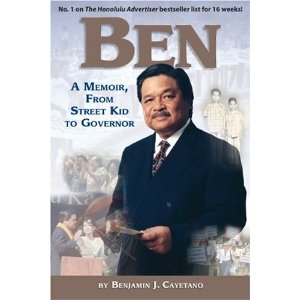
Benjamin Cayetano: _Ben: A Memoir, from Street Kid to Governor_

Benjamin Cayetano's autobiography provides a surprisingly engaging, personal, and compelling read from an intensely private, seemingly aloof public figure.  Born into a broken home in working-class Kalihi, Cayetano documents the evolution of his intellect and social conscience amidst struggle and hardship. While the bittersweet, poignant reflections on childhood and family will speak to a broad audience, political junkies will delight in the latter sections that offer insider perspective on Hawaii politics and the dirty dealings and scandals that're the underbelly of government.  

Wednesday, September 22, 2010

M.T. Anderson, _The Feed_

In M.T. Anderson's dystopic young adult novel, everyone has a feed, a digital implant that streams media 24/7 to users, rendering critical thinking and articulateness obsolete.  Titus, the novel's protagonist, has spent his entire life dependent on the feed, but when he and his friends take a lunar trip for spring break, he meets a subversive, Violet, who makes him question the status quo for the first time.  Wickedly satirical, Anderson extrapolates on current 21st century realities, including environmental degradation, digital dumbing-down, targeted marketing, and materialistic, self-indulgent teen lemmings who mindlessly adopt the latest fashion trends, no matter how fatuous (hey, check out my cool lesions!).  He does a particularly masterful job skewering linguistic deterioration: adolescents utilize a superficial, minimalist, neo-California style sociolect, chock full of fillers, profanity, and hedges, and devoid of any lexical richness or edge, e.g. "Unit!  She's meg-youch!", while government officials spout political doublespeak to obfuscate cruel truths and conceal lies.  Naturally, the novel's lone radical stubbornly resists the societal language trend, protesting the debasing of English by speaking "entirely in weird words and irony, so no one can simplify anything he says" (137).    Provocative and relentless.

Bryce Courtenay, _The Power of One_

Buster, one of my freshman English Award winners and an astute, avid reader, gifted me with this novel, his "favorite book", before school let out for summer.  Indeed, a terrific, affirming page-turner on every account.  Bryce Courtenay's The Power of One is a classic bildungsroman, chronicling the life of Peekay (short for "Pisskopf", the derogatory moniker conferred by school bullies), a precocious white English intellectual growing up in Boer-dominated, apartheid South Africa.  A classic "underdog defies odds" novel, the story celebrates Peekay's resistance against the forces that break the human spirit and his efforts to forge his identity as a pugilist, free-thinking intellectual, and activist for social justice.

Monday, May 17, 2010

Greg Mortensen, _Three Cups of Tea_ and _Stones Into Schools_


In these two non-fiction accounts, Greg Mortensen, head of the Central Asia Institute, documents how a failed mountaineering expedition serendipitously led to his life-changing grassroots mission to educate the impoverished girls of Pakistan and Afghanistan, and in doing so, promoting peace and stability in the region.  Although the pace of both books occasionally bogs down in blow-by-blow details and you'll undoubtedly find yourself reaching for a map to track the peripatetic wanderings of Mortensen and his energetic staff, the narratives are full of wonderful cross-cultural moments, at turns poignant, dramatic, and humorous.  Most importantly, Mortensen's work kindles the hope that idealistic individuals can indeed change the world for the better and go where governments and armies fail to tread, one relationship at a time.

Neal Shusterman, _Unwind_


The setting: the United States, in a future not so distant from now. After the violent Second Civil War, pro-life and pro-choice sides have reached a compromise. From 0-13, life is sacred. From 13-18, however, parents may retroactively abort or "unwind" undesirable minors.  And why not transform societal dross into the good and useful, especially because medical science can use 100% of their bodies for organ transplants? Connor is a rebellious teen whose parents have decided, once and for all, to erase his existence.  Risa, a ward of the state and once promising piano prodigy, has fallen short in her musical studies, and due to budget cuts, has been slated for termination.  And Lev's devoutly religious family has groomed their youngest son his entire life as a human sacrifice for God and the greater good.  Together, the three fight for survival in Neal Shusterman's dark, Swiftian dystopia.  A fast-paced, discussion-provoking read, sure to engage even reluctant readers.

Thursday, April 1, 2010

Alice Hoffman, _Incantation_


Alice Hoffman weaves an elegant, poetic tale of love, betrayal, and secret identity, set during the Spanish Inquisition.  Sixteen year old Estrella deMadrigal believes the bond between herself and best friend, Catalina, can never be severed--that is, until she kisses Andres, Catalina's betrothed, and falls in love.  Their covert romance ignites a series of harrowing events which unearth the shadowy history of Estrella's family.   A novella--only 166 pages long--this is a captivating story, one well-suited for teens: simple and a quick read, yet alluring: rich in passion, emotional intensity, and authorial craft.

Thursday, March 18, 2010

H.G. Bissinger, Friday Night Lights


Friday Night Lights: A Town, a Team, and a Dream, by H.G. Bissinger, is a title often mentioned by students when lauding must-read books.  Not being much of a football fan--horrors! that's a heretical confession for a teacher at a college-prep school famous for its academics, but also for its pin-up status in the pages of Sports Illustrated--I never did get around to reading it.  But, I finally did, and thus far, my students, as usual, are batting a thousand when it comes to good recommendations.

Mixed sports metaphors aside, Bissinger offers up a reflective, documentary journalism-style examination of one fateful season in the history of the Permian Panthers, a small-town Texan high-school football team.  Bissinger lovingly documents the obsessiveness surrounding the sport  and highlights the dramas on the athletic field and in the locker room.  Yet Friday Night Lights is so much more than a non-fiction book about football and the adolescents who play it; rather, Bissinger reveals the integral role that the sport plays in the life of Odessa, Texas, and how it is inextricably interwoven with the town's socioeconomics, race relations, and educational context.  

Monday, March 8, 2010

Libba Bray, _Going Bovine_


What do you get when you cross Cervantes with The Catcher in the Rye, and toss in the deadly Creutzfeldt-Jakob pathogen, a pink-haired angel in combat boots, a talking yard gnome, physics, a time-traveling Inuit rock band, and kitschy snow globes? In her latest novel, Going Bovine, winner of the Michael L. Printz Award for young adult literature, Libba Bray delivers a hallucinogenic mix of social satire peppered with allusions from literature, mythology, and pop culture. This dark, brilliantly crafted page-turner is, by turns, laugh-out-loud hysterical, sublimely surreal, and poignantly philosophic.

The basic premise:
When alienated 16 year old slacker, Cameron Smith, is diagnosed with mad-cow disease, he and his "Sancho Panza", a hypochondriac, video-gaming dwarf, Gonzo, embark on a wild road trip to find a cure, with stops in Mardi Gras New Orleans, the Church of Everlasting Satisfaction and Snack-n-Bowl, the Ya! Party House in Daytona, and Disney World.  Yet their long, strange journey is a metaphoric one, as well: one of self-examination, discovery, and love.

Don't hurt your happiness.  Borrow this addictive book now.

Friday, March 5, 2010

Sue Monk Kidd, _The Secret Life of Bees_


Several students of mine recommended Sue Monk Kidd's acclaimed first novel, The Secret Life of Bees, to me over the past few years, and as usual, I am glad I took them up on it, for it is truly a taste of honey: a compelling, lovely narrative which marries gorgeous, lyrical language, authorial crafting, symbolism, and substance. In fact, I liked this novel so well that I successfully convinced the Hogwarts English I subdepartment to adopt it as one of our required novels.

Without revealing any spoilers, here's the premise. It is the summer of 1964, South Carolina. Resilient 14 year old loner, Lily Melissa Owens, lives with her abusive father, T. Ray; she is haunted by a traumatic childhood incident which has left her motherless. Shortly after the Civil Rights Act is passed, Lily's nanny, Rosaleen, goes to town to register to vote, taking Lily with her. When Rosaleen spits snuff juice on the shoes of a notorious town racist, however, it sets in motion a dramatic chain of events, which get both in trouble with the law. The two fugitives seek refuge in Tiburon, South Carolina, where Lily hopes to unlock her dead mother's mysterious past. A trio of African-American women take Lily and Rosaleen in, and as the novel unfolds, Lily confronts civil rights issues, discovers love, and comes to terms with her troubled past.

Tuesday, January 12, 2010

John Ratey, _Spark: The Revolutionary New Science of Exercise and the Brain_


As a student at Hogwarts Academy, I used to kvetch about mandatory K-12 PE and the way that undesirable sports activities inevitably eroded my hard-earned GPA. A klutz in comparison to my Varsity-letter decorated classmates, I was the girl who lobbed tennis balls over the court walls, not because I was deliberately evading P.E.--that would've entailed way too much hand-eye coordination on my part--but because of simple misfires. Yet, I grudgingly admit that over the years, I began loving physical exertion, especially when I was allowed to elect my own exercise regimen, whether it was cartwheeling across a balance beam, striking the "Warrior Dancer" asana in yoga, or mastering Shotokan karate kata. At Hogwarts, I also discovered early that I had a talent for long-distance running and relished the easy fluid meditation of running through the streets of Manoa and Makiki and St. Louis Heights in the early morning hours. Ironically, I, the high school klutz, discovered my inner athlete in college and graduate school. My earlier struggles with coordination, as if by magic, ceased, and I found that that a steady daily diet of running, swimming, dance, and yoga provided a welcome respite from daily stress and academic pressures; if anything, I felt more grounded and sharper, simply by making time to exercise. Turns out that my alma mater's staunch conviction, echoing the Greek classical principle of "sound mind, sound body," was absolutely founded in truth: research that's borne out by John Ratey's excellent book.

Ratey's Spark: The Revolutionary New Science of Exercise and the Brain, is the most fascinating and inspiring text I've perused in a long spell: a must-read for educators and anyone who's interested in optimizing their holistic health and cognitive resources, decreasing stress, and staving off mental, as well as overall physical degeneration (that's everyone, right?). An associate clinical professor of psychiatry at Harvard Medical School, Ratey examines the myriad benefits that exercise has on cognition, summarized here. Exercise

1. Strengthens the cardiovascular system, creating less strain on the body's and brain's blood vessels. It helps neurogenesis, as well as counteracts vascular damage.
2. Regulates fuel. Insulin levels drop with aging, creating waste products in cells that damage blood vessels, which then increase stroke risk. Exercise helps the body's efficiency.
3. Reduces obesity.
4. Elevates stress threshold: while some cortisol, a neurotransmitter released during stress, is good, chronic overload is deleterious and triggers cell death.
5. Lifts mood. Neurotransmitters, neurotrophins, and connectivity shore up the hippocampus against atrophy associated with depression and anxiety. Elevated mood also reduces one's chances of developing dementia.
6. Boosts immune system by rallying immune systems antibodies and T cells. Lack of activity poses the greatest risk factor for cancer.
7. Fortifies bones, reducing osteoporosis risk.
8. Boosts motivation by counteracting the natural decline of dopamine.
9. Fosters neuroplasticity. Building a strong brain guards agains neurodegenerative disease. Moving the body also elevates the supply of neurotrophic factors necessary for neuroplasticity and neurogenesis, as well. Furthermore, aerobic exercise further strengthens connections between brain cells, creating more synapses, causing stem cell division, and forming more functional neurons in the hippocampus.
10. If combined with cognitive challenge, helps to build neural networks. In moderation, the stress created by aerobic physical exertion, followed by mental/intellectual stimulation, is beneficial. Hence, one could reasonably expect students' classroom performance and mental acuity to increase, if P.E. was a regular part of their daily school curriculum; it'd be particularly optimal if P.E. was scheduled first thing in the morning.

I strongly recommend Ratey's book. Provocative, it may well transform the way you teach, view exercise and overall health, and change your--and others'--lives.

Tuesday, December 15, 2009

Taylor Clark, _Starbucked: A Double Tall Tale of Caffeine, Commerce, and Culture_


Long ago, in a verdant valley not so far away, dwelt a small coffeehouse located in a small suburban strip mall. Though its daily brew was admittedly acrid, Coffee Manoa nevertheless created a haven. Kathy, the owner/head barista, knew everyone by name, greeting customers with warm aloha, and the locale was perpetually blessed by double rainbows arcing above the tangle of aerial cables, the then-KC Drive Inn, and the slick, inky, oil-slicked concrete expanse of the Manoa Marketplace parking lot. There, eccentric poets, artists, professors, poor students, up-and-coming folk musicians, counter-culture holdovers, and caffeine junkies alike held court, recited Proust, debated philosophical issues, played endless games of chess, and lingered at the outdoor tables for hours, long after the last orts of scone had been fed to the ravenous doves and the espresso drained to the lees, without fear of expulsion from Eden. And then, one day, Starbucks moved in on the corner of East Manoa and Huapala, a site haunted by businesses past: Bank of America, and before that, Manoa Chop Suey. Coffee Manoa shuttered its windows, and the neighborhood was never quite the same after that...

Despite its decidedly mixed critical reviews, I found Taylor Clark's Starbucked: A Double Tall Tale of Caffeine, Commerce, and Culture an addictive, fun, and fast read. Clark chronicles the rise of legendary corporate giant Starbucks: how it built its expansive, international empire of clean, well-lighted coffeehouses and became those popular, yet simultaneously despised purveyors of tasteful music, pandering to high-maintenance no-dairy, double-venti caramel frappucino drinkers. He also documents the social history of coffee and America's consumption of the glorious bean, as well as ponders the ethical quagmire surrounding the economics of coffee (if you buy Fair Trade, can you drink your morning brew, sans guilt?) Clark also offers some provocative tidbits: contrary to popular conspiracy notions that Starbucks single-handedly deals death-blows to small, mom-and-pop cafes like Coffee Manoa, the caffeine mogul's ubiquitous presence actually increases sales at competitor coffeehouses, something you might've already surmised, taking a gander at the brisk action happening at the Manoa branch of Coffee Bean and Tea Leaf, just a stone's throw from the aforementioned Starbucks. So grab a cuppa joe, and start reading.

Thursday, November 12, 2009

Push Yourself Up

For the past 2 years, every semester the English Department has published an in-house chapbook called Banter. Since I'm a notoriously undisciplined writer when left to my own devices, I've found that the social pressure to submit pieces to said publication provides nice incentive to write.

This fall, Paul, our department head, provided 9 different college essay prompts to choose from, and asked us to write an essay of not more than 450 words. For the record, this is 448. I've been tossing this piece around in my mind for a while and suspect this incarnation could still use additional tweaking. But here goes...

If you were to look back on your high school years, what advice would you give to someone beginning their high school career? (Simmons College, Essay Prompt 2009)


PUSH YOURSELF UP

At first, she lies prostrate, face down, unmoving. Then she writhes and strains, grimacing in pain, an accusing eye searing into us: stone-hearted sadists, Stasi, tormentors. Pitiful mews crescendo to banshee wails, but she pleads in vain. We are impassive. Her leaden skull lifts fractionally for a split-second, then crashes, face first, to the ground. Torture? No: tummy time.

During tummy time, parents place infants on their stomachs, preventing them from staying in one position. The daily exercise promotes neck and shoulder development, priming the muscles that enable children to roll, sit, and eventually crawl. Constant repositioning, pediatricians opine, promotes infant development, preventing skull-flattening and muscle atrophy. But what doctors don’t divulge is that for many babies, ours included, tummy time is a daily dose of unadulterated hell—initially.

Then, in month 2, we have a breakthrough. One day, we deposit our resentful spitfire onto her quilt for her requisite 15 minutes of tummy torture, chanting, “Go, little girl! You can do it!” But our choleric daughter will have none of it. Her toes claw viciously at the unyielding floor, while her face, a hostile, wrinkled, red walnut, sounds the alarm: “WAAAAHHHHHH--” Suddenly, screeching ceases: arrested, mid-shriek, by silence. Mystified, she looks down to find she’s attained naga-asana, propped on her elbows, chest raised, head erect as a flag. She glances at us, face blossoming with laughter as she savors her newfound equilibrium. In the days that follow, our baby continues to push herself up. And we find her exploring new frontiers, raising a hand off the mat, then shifting to the other, or gleefully rolling, a miniature firkin, barreling from belly to back to belly again.

In yoga, it is said that the faithful practice of naga-asana, the cobra pose, awakens kundalini: a creative, spiritual energy, coiled at the base of the spine, that expands consciousness. In life too, we open new vistas and strengthen ourselves through motion--through struggle, not stasis. Yet we too often gravitate to security, retreating to the comfort of what is easy or familiar, even when it’s detrimental. Sometimes, when we seem to be making no headway, despite our best efforts, we’re tempted to quit or seek refuge in what we do well, imprisoning ourselves by distrusting our power within. Progress and personal growth, however, are never automatic, nor do they spring from luck or talent. Rather, they demand commitment and sustained effort through tribulation. So, when things are tough and obstacles insurmountable, dare. Persevere. Have faith. You’ll never know what you can truly accomplish until you test your boundaries. Brave those challenges, step by step, moment by moment, trial by trial. You were meant to do this. Push yourself up.

Thursday, October 15, 2009

Stuart Brown, _Play: How It Shapes the Brain, Opens the Imagination, and Invigorates the Soul_


(Caveat: a literary rant follows! But if you were contemplating reading this title, I'll give you the short executive summary, to spare you precious reading time.)

Alas, that this book in no way lives up to the promise of its title! I was hoping for some juicy neurological research examining the importance of play, in order to glean some teaching ideas, but no, no, no. Brown, a medical doctor, psychiatrist, clinical researcher, and founder of the National Institute for Play, treads the road oft taken. No scientific knowledge is needed to understand that humans, like animals, learn by playing, acquiring the skills for survival, successful social interaction, and conflict management, and that we gain resilience as a result. It also is a no-brainer that we are happier and more engaged, to paraphrase Robert Frost, when our avocation and vocation are united. What gives us pleasure and inspires passion ought to be merged with our work.

So, these are the three key points for teaching:
1. Novelty activates the brain.
2. Make things fun.
3. Risk, generally, is an important and positive element learned by playing--though Brown undercuts his own argument by noting that naturally, we want to strike a happy balance between allowing people to risk, and potentially fail, as long as the consequences don't severely compromise one's safety, and/or prove fatal. Duh.

Thursday, October 8, 2009

Elizabeth Bunce, _A Curse Dark As Gold_


Winner of the American Library Association's William C. Morris Debut Award, Elizabeth Bunce's A Curse Dark As Gold is a suspenseful retelling of the Rumplestiltskin fairy tale, set in the late 1700s at the dawning of the Industrial Revolution. The story opens with a funeral: plucky and headstrong Charlotte Miller, along with her younger sister Rosellen, have been orphaned. The two daughters are the lone survivors of the Miller clan, the family that runs "Stirwaters", the mill of Shearing Village. Their family enterprise is plagued by financial troubles, as well as an evil curse which has destroyed generations of male Miller heirs. In the face of calamity, however, Charlotte not only assumes the mantle of Stirwaters' miller but also the burden of breaking the black magic, once and for all. A heady brew of fantasy, historical fiction, romance, intrigue, and superstition, this novel delights.

Thursday, July 2, 2009

Gene Luen Yang, _American Born Chinese_


Although I'm not normally a big fan of graphic novels, I was enthralled with Gene Yang's amazing graphic novel, American Born Chinese, which I recently borrowed from my local library. The book, a finalist for the National Book Award-Young People's Literature category, and winner of the 2007 Michael L. Printz Award, encompasses three different narrative threads, all deftly woven together at the novel's conclusion: the story of the likeable Jin Wang, a Taiwanese immigrant struggling with issues of cultural identity, teenage angst, and girl problems; a mythic strand about the fabled Monkey King of Chinese legend, who, fueled by desire to earn the reverence due to a deity, seeks transcendence from his simian roots; and a surreal third strand about an all-American boy, Danny, who is haunted by a visiting relative, Cousin Chin-Kee, an Asian-stereotype incarnate. Suitable for young adults, this novel has style, substance, and heart, as well as an uplifting message about self-acceptance.

Monday, February 23, 2009

Cormac McCarthy, _The Road_


Cormac McCarthy's Pulitzer Prize-winnning novel details the harrowing adventures of a son and his father, two survivors in a post-apocalyptic world, making their way to the coast. I'm not normally a fan of McCarthy, but the novel's spare, muscular prose, as well as the poignancy and suspensefulness of the situation, kept me turning pages. A difficult read--I felt emotionally drained upon the book's completion, as there are no fairy-tale endings for this family of two. Still, I'm praying that there's a glimmer of hope for the boy--that his resilience, fueled by the enduring love of his father, will be the sustaining fire that abides in him, despite the charred destruction without.

Friday, November 14, 2008

The Unbearable Lightness of Connection: Face to Face with Facebook


In an effort to remind us that we are writers, as well as readers and teachers, my department head, Paul, asked English Department members to write something, no more than a page in length, that speaks to our role as teachers. Plagued for weeks by the paralysis of integrity--please God, let me write something halfway decent!--I finally came up with the essay below, slightly edited for public consumption. Reading over it, I'm reminded that I've never been particularly good at just answering the question directly.

A few weeks back, I joined Facebook, the ubiquitous social networking site, as an experiment. “So what’s the big deal?” I wondered. Why do students--and full-grown adults--spend hours tricking out spaces and festooning the Ether with their glamorous profiles? Why fritter away time “poking” people, playing Twirl, or taking quizzes to discover what kind of Asian you are or whether you’re smarter than Paris Hilton (and what does it say about you if you need to take a quiz to find out)? Why send virtual snowmen, ZipPacs, morel mushrooms, or good karma to 1,001 buddies? Why broadcast banal, quotidian details to the world? And with just a few extra mouse clicks, how ‘bout saving endangered animals, the rainforest, or greening your vino while you’re at it? Logging on, I am blizzarded by people’s photographic flurries of selves, kids, and significant others, baby announcements, romantic fallout, spontaneous declarations, sexual orientations, political affiliations, and house renovations. Thanks to Facebook, I know that Sheryl enjoys “So You Think You Can Dance” and Truffaut; that Candace kissed Barack Obama; that Liz is “astounded by this modern world of friendship; will she be able to get back to work?” (Liz: ain’t gonna happen, ‘cause Anita’s your guide into the abyss!), and that some Hogwarts ‘88ers still toast with “Oh, L’Amour” champagne flutes (as opposed to my own prom memorabilia, which’d been unceremoniously crated and deep-sixed at the Tank, après-graduation). Then there’s Wild West photo tagging--wasn’t there a “Do Not Resuscitate” sign on my bespectacled, gangly seventh grade self? Not to mention that rather torrid discussion on the ’88 class page about the “hotest” (ay, ay, ay: so much for a quality Hogwarts English education!) Hogwarts faculty member. Who could forget Mrs. Rouser, my freshman Algebra teacher and Fiero-speedster: she of the high-teased hair, black leather miniskirt, and electric blue mascara--gotta love the 80s!--and the day she staggered on her hot-pink, 4-inch stilettos while chalking variable equations and plummeted onto the tiled Bingham floor, like an ungainly exotic bird? Indeed, we are slaves to fashion, nostalgia, and our evolving public identities.

Early on in my experiment, my cousin Ralph commented, “If you haven't already gotten the intricacies of Facebook, you'll soon find you can learn a lot by not doing much at all.” He certainly got that right. And as my illustrious colleague, Jack, confided, there’s a certain voyeuristic pleasure in uncovering what students are really up to. Web 2.0 espionage, here we come! For many, Facebook also provides a notorious haven from homework, a den of scurrilous gossip, and a refuge from responsibility, though there’s genuine pleasure in reestablishing contact with long-lost amici. In my Inbox: messages from a ballet sister I’ve not laid eyes on for 20 years, a classmate turned high-profile lawyer/occasional Cambridge coffeehouse chanteuse, and an activist friend who’s officiating same-sex marriages with his recently-minted divinity degree. Friends: souvenirs of a life.

But arguably, the true attraction of Facebook is that you can literally construct and reconstruct your ideal self: the face you show the world. The site allows you to write your identity; weigh your worth, gauging popularity by friends and virtual tchotchkes acquired; and shamelessly brag in a socially-legitimate way-- like a post-modern holiday letter--and get comments besides! And by posting playlists, photo albums, booklists, causes, links, and sundry artifacts of your persona, you establish a fossil record that asserts your being. Yes, I exist. Yes, I matter. Yes, my thoughts have significance.

On a superficial level, Facebook provides community and connectedness—instantaneously, I’m apprised of my colleagues’, friends’, and students’ comings and goings. And sure, it’s beautiful to find unexpected well-wishes scrawled on my Wall and see loved ones waving at me from distant shores, from Escazu to Stockholm, Maine to Manhattan. That virtual sushi’s not half-bad, either. But ironically, Facebook leaves me hungry for the genuine, the real, the substantial: Eliza’s lush bouquet of spicy homegrown basil; a leisurely lunch with good company and conversation; the coos of Ligaya’s baby; the taste of Everett’s freshly-baked pumpkin bread, still warm from the oven; Charla’s daughter squishing strawberry guavas with Ella on Wa`ahila Ridge Trail: a second generation of friends; Richard and Martine arguing the merits of utilitarianism; Shyrl considering the art of absence, en français, no less; Kai’s illuminating smile; and the resonant strains of Dvorak as Hunter bends over his cello. Truly, it is not through digital means, but by living and savoring the here and now, and yes, by teaching and learning, that we affirm our irreplaceable, measureless, unseverable bond.

Wednesday, November 5, 2008

Obama Surfs Into 1600 Pennsylvania Avenue


In a historic election yesterday, Barack Obama clinched the United States Presidential race, becoming the first African-American, Punahou graduate, Hawaii-born, not to mention hapa-haole, bodysurfing, slippah-wearing, plate-lunch devouring president-elect. His inspiring victory speech shows that Obama, like his 19th century predecessor from Illinois, is an astute student of rhetoric and literature. Rich with anaphora, alliteration epistrophe, and antithesis, Obama's words echo Walt Whitman's patriotic optimism and contain allusions to the Great Emancipator's Gettysburg Address, Martin Luther King Jr's 8/23/63 Lincoln Memorial Speech (a.k.a. I Have A Dream) and April 3, 1968 "I've Been to the Mountaintop" speeches. There's something reminiscent of Shakespeare's Henry V's "St. Crispian's Day Speech" in it, as well, and as always, Obama's omnipresent tropes of the "American Dream" and Winthrop's "City on a Hill".

Below is a video of the speech, courtesy MSNBC.com followed by the prepared text of Barack Obama's victory speech, delivered in Chicago, on November 4, 2008. It comes courtesy of National Public Radio.
URL: http://www.npr.org/templates/story/story.php?storyId=96624326

NPR.org, November 5, 2008 ·

In these prepared remarks provided by his campaign, President-Elect Barack Obama calls himself the unlikeliest presidential candidate. He thanks many members of his campaign, along with his enormous army of volunteers, and he warns supporters about what he calls the enormity of the tasks at hand that now face the U.S. He concludes by telling an anecdote about a 106-year-old African-American voter from Atlanta.


If there is anyone out there who still doubts that America is a place where all things are possible; who still wonders if the dream of our founders is alive in our time; who still questions the power of our democracy, tonight is your answer.

It's the answer told by lines that stretched around schools and churches in numbers this nation has never seen; by people who waited three hours and four hours, many for the very first time in their lives, because they believed that this time must be different; that their voice could be that difference.

It's the answer spoken by young and old, rich and poor, Democrat and Republican, black, white, Latino, Asian, Native American, gay, straight, disabled and not disabled — Americans who sent a message to the world that we have never been a collection of red states and blue states; we are, and always will be, the United States of America.

It's the answer that led those who have been told for so long by so many to be cynical, and fearful, and doubtful of what we can achieve to put their hands on the arc of history and bend it once more toward the hope of a better day.

It's been a long time coming, but tonight, because of what we did on this day, in this election, at this defining moment, change has come to America.

I just received a very gracious call from Sen. McCain. He fought long and hard in this campaign, and he's fought even longer and harder for the country he loves. He has endured sacrifices for America that most of us cannot begin to imagine, and we are better off for the service rendered by this brave and selfless leader. I congratulate him and Gov. Palin for all they have achieved, and I look forward to working with them to renew this nation's promise in the months ahead.

I want to thank my partner in this journey, a man who campaigned from his heart and spoke for the men and women he grew up with on the streets of Scranton and rode with on that train home to Delaware, the vice-president-elect of the United States, Joe Biden.

I would not be standing here tonight without the unyielding support of my best friend for the last 16 years, the rock of our family and the love of my life, our nation's next first lady, Michelle Obama. Sasha and Malia, I love you both so much, and you have earned the new puppy that's coming with us to the White House. And while she's no longer with us, I know my grandmother is watching, along with the family that made me who I am. I miss them tonight, and know that my debt to them is beyond measure.

To my campaign manager, David Plouffe; my chief strategist, David Axelrod; and the best campaign team ever assembled in the history of politics — you made this happen, and I am forever grateful for what you've sacrificed to get it done.

But above all, I will never forget who this victory truly belongs to — it belongs to you.

I was never the likeliest candidate for this office. We didn't start with much money or many endorsements. Our campaign was not hatched in the halls of Washington — it began in the backyards of Des Moines and the living rooms of Concord and the front porches of Charleston.

It was built by working men and women who dug into what little savings they had to give $5 and $10 and $20 to this cause. It grew strength from the young people who rejected the myth of their generation's apathy; who left their homes and their families for jobs that offered little pay and less sleep; from the not-so-young people who braved the bitter cold and scorching heat to knock on the doors of perfect strangers; from the millions of Americans who volunteered and organized, and proved that more than two centuries later, a government of the people, by the people and for the people has not perished from this earth. This is your victory.

I know you didn't do this just to win an election, and I know you didn't do it for me. You did it because you understand the enormity of the task that lies ahead. For even as we celebrate tonight, we know the challenges that tomorrow will bring are the greatest of our lifetime — two wars, a planet in peril, the worst financial crisis in a century. Even as we stand here tonight, we know there are brave Americans waking up in the deserts of Iraq and the mountains of Afghanistan to risk their lives for us. There are mothers and fathers who will lie awake after their children fall asleep and wonder how they'll make the mortgage, or pay their doctor's bills, or save enough for college. There is new energy to harness and new jobs to be created; new schools to build and threats to meet and alliances to repair.

The road ahead will be long. Our climb will be steep. We may not get there in one year, or even one term, but America — I have never been more hopeful than I am tonight that we will get there. I promise you: We as a people will get there.

There will be setbacks and false starts. There are many who won't agree with every decision or policy I make as president, and we know that government can't solve every problem. But I will always be honest with you about the challenges we face. I will listen to you, especially when we disagree. And, above all, I will ask you join in the work of remaking this nation the only way it's been done in America for 221 years — block by block, brick by brick, callused hand by callused hand.

What began 21 months ago in the depths of winter must not end on this autumn night. This victory alone is not the change we seek — it is only the chance for us to make that change. And that cannot happen if we go back to the way things were. It cannot happen without you.

So let us summon a new spirit of patriotism; of service and responsibility where each of us resolves to pitch in and work harder and look after not only ourselves, but each other. Let us remember that if this financial crisis taught us anything, it's that we cannot have a thriving Wall Street while Main Street suffers. In this country, we rise or fall as one nation — as one people.

Let us resist the temptation to fall back on the same partisanship and pettiness and immaturity that has poisoned our politics for so long. Let us remember that it was a man from this state who first carried the banner of the Republican Party to the White House — a party founded on the values of self-reliance, individual liberty and national unity. Those are values we all share, and while the Democratic Party has won a great victory tonight, we do so with a measure of humility and determination to heal the divides that have held back our progress.

As Lincoln said to a nation far more divided than ours, "We are not enemies, but friends... Though passion may have strained, it must not break our bonds of affection." And, to those Americans whose support I have yet to earn, I may not have won your vote, but I hear your voices, I need your help, and I will be your president, too.

And to all those watching tonight from beyond our shores, from parliaments and palaces to those who are huddled around radios in the forgotten corners of our world — our stories are singular, but our destiny is shared, and a new dawn of American leadership is at hand. To those who would tear this world down: We will defeat you. To those who seek peace and security: We support you. And to all those who have wondered if America's beacon still burns as bright: Tonight, we proved once more that the true strength of our nation comes not from the might of our arms or the scale of our wealth, but from the enduring power of our ideals: democracy, liberty, opportunity and unyielding hope.

For that is the true genius of America — that America can change. Our union can be perfected. And what we have already achieved gives us hope for what we can and must achieve tomorrow.

This election had many firsts and many stories that will be told for generations. But one that's on my mind tonight is about a woman who cast her ballot in Atlanta. She's a lot like the millions of others who stood in line to make their voice heard in this election, except for one thing: Ann Nixon Cooper is 106 years old.

She was born just a generation past slavery; a time when there were no cars on the road or planes in the sky; when someone like her couldn't vote for two reasons — because she was a woman and because of the color of her skin.

And tonight, I think about all that she's seen throughout her century in America — the heartache and the hope; the struggle and the progress; the times we were told that we can't and the people who pressed on with that American creed: Yes, we can.

At a time when women's voices were silenced and their hopes dismissed, she lived to see them stand up and speak out and reach for the ballot. Yes, we can.

When there was despair in the Dust Bowl and depression across the land, she saw a nation conquer fear itself with a New Deal, new jobs and a new sense of common purpose. Yes, we can.

When the bombs fell on our harbor and tyranny threatened the world, she was there to witness a generation rise to greatness and a democracy was saved. Yes, we can.

She was there for the buses in Montgomery, the hoses in Birmingham, a bridge in Selma and a preacher from Atlanta who told a people that "We Shall Overcome." Yes, we can.

A man touched down on the moon, a wall came down in Berlin, a world was connected by our own science and imagination. And this year, in this election, she touched her finger to a screen and cast her vote, because after 106 years in America, through the best of times and the darkest of hours, she knows how America can change. Yes, we can.

America, we have come so far. We have seen so much. But there is so much more to do. So tonight, let us ask ourselves: If our children should live to see the next century; if my daughters should be so lucky to live as long as Ann Nixon Cooper, what change will they see? What progress will we have made?

This is our chance to answer that call. This is our moment. This is our time — to put our people back to work and open doors of opportunity for our kids; to restore prosperity and promote the cause of peace; to reclaim the American Dream and reaffirm that fundamental truth that out of many, we are one; that while we breathe, we hope, and where we are met with cynicism, and doubt, and those who tell us that we can't, we will respond with that timeless creed that sums up the spirit of a people: Yes, we can.

Thank you, God bless you, and may God bless the United States of America.